
Wellington · Somerset · Mid Devon
Groundworks in Wellingtonand across Somerset:the half you never see
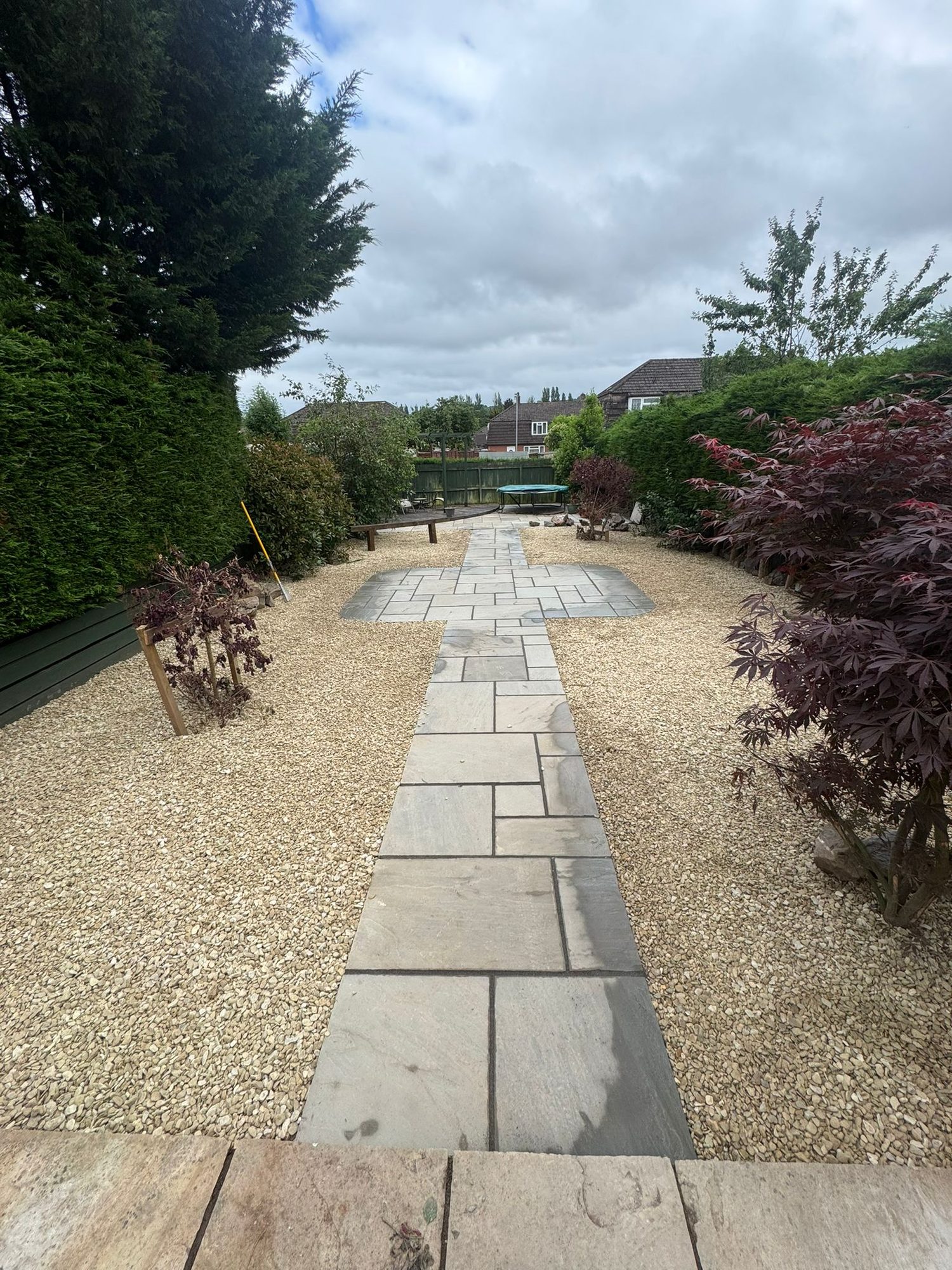
Foundations, drainage and site preparation carried out as part of our own landscaping projects, so the paving, walls and timber above them sit on ground that has actually been prepared.
Free site visit · Itemised written quote usually within a week · Written contract on every job
6 years
Landscaping experience, backed by 30+ years in carpentry, joinery and building
4-strong
Family team on site, the people who quoted the job do the work
9
Five-star reviews from homeowners across Somerset and Mid Devon
Free
Site visit and itemised written quote, usually back within a week
In writing
Written contract signed by both parties on every job
Service Overview
What groundworks covers
Groundworks is everything that happens before the visible garden begins: clearance, excavation, muck away, levelling, compaction, drainage runs, soakaways, and the concrete foundations for walls, garden rooms and structures. It is the least photogenic part of a project and the part that decides whether the finished garden performs.
We carry out groundworks as part of our own landscaping projects for private clients rather than as a standalone contracting service. In practice that means the people digging the base are the same people laying the slabs on top of it, so there is no argument later about whether the base or the surface caused a problem.
The work always starts with what is actually in the ground. Somerset plots vary from heavy clay that holds water for weeks to shallow soil over stone, and each dictates a different dig depth, sub-base thickness and drainage strategy. We check that at the site visit rather than pricing a standard build-up and hoping.
Levels and falls are set with instruments, not judged by eye. Getting the finished levels right at excavation stage is what keeps paving below the damp proof course, keeps thresholds usable and stops the garden draining towards the house.
Who it is for
Homeowners whose landscaping project needs proper preparation underneath: new patios, driveways, garden rooms, walls or lawns.
When it is needed
When the ground is waterlogged, when levels have to change, when a structure needs a foundation, or when a plot has been compacted and damaged by earlier building work.
Why a professional build matters
Everything above the ground depends on it, and none of it can be inspected or corrected afterwards without lifting the finished work.
How we work
As part of our own landscaping schemes for private clients. We are not taking on commercial groundworks contracts at present.
Request your free quote
Free site visit, itemised written quote, typically back with you inside a week.
Prefer to talk it through? Call 07340 000463 between 8am and 8pm, Monday to Saturday.
What Happens If It Waits
What poor preparation costs later
Skipping preparation is the cheapest decision on day one and the most expensive over five years. A patio laid on unremoved topsoil settles as the organic material breaks down, and no amount of surface repair fixes it. A driveway on a thin, uncompacted base ruts under the wheels within a couple of winters. A shed or garden room on inadequate foundations racks, and the doors stop closing.
Water is the other half of the problem. Ground that is not drained keeps every layer above it wet: sub-bases soften, mortar joints stay damp and blow, timber in ground contact rots, and lawns turn to moss. Because the cause is invisible, people replace the surface, watch the same failure happen again, and pay twice.
There is also the disruption cost. Correcting groundworks after the event means lifting finished paving, dismantling walls or taking up turf, then doing the excavation that should have happened first, then rebuilding everything on top. The dig itself is rarely the biggest line in that bill.
Common mistakes we are called in to fix
Building on topsoil
Organic material compresses and decays under load. If it is not dug out and carted away, the surface above it will follow it down.
Tipping the sub-base in one lift
Stone has to be laid and compacted in layers with the right plant. A single deep uncompacted layer settles unevenly under load.
No thought for where water goes
Every square metre of new hard surface produces run-off. Without falls, soakaways or land drainage it collects at the lowest point, often against the house.
Raising levels against the building
Bringing ground or paving up over the damp proof course or an airbrick invites damp problems that cost far more to fix than the groundwork saved.
Our Process
How we approach groundworks
- 1
Free site visit and ground assessment
We check ground conditions, existing levels, where water arrives and drains, access for machinery and where spoil can be loaded out.
- 2
Itemised written quote
Clearance, excavation, muck away, membrane, sub-base, drainage, concrete and reinstatement are all priced as separate lines, usually back within a week.
- 3
Written contract and programme
Both parties sign off scope, price and timings. A 50% deposit is taken with the balance on completion by bank transfer.
- 4
Clearance, excavation and muck away
Vegetation and unsuitable material are cleared, the area is dug to depth, and the spoil is removed from site rather than piled in a corner of the garden.
- 5
Drainage, base and level check
Drainage runs and soakaways go in, sub-base is laid and compacted in layers, and finished levels and falls are checked before any surface work begins.
The Benefits
What good groundworks buys you
Surfaces that stay flat
A properly excavated and compacted base means paving and driveways hold their level instead of settling into wheel tracks and dips.
A dry garden
Land drainage, soakaways and set falls take water away from the house and off the usable areas of the garden.
Structures that stand square
Concrete foundations sized for the load keep walls, garden rooms and sheds true, so doors and openings still work in five years.
No repeat spend
Doing the invisible half once removes the cycle of relaying, repairing and relaying the visible half.
One team, one responsibility
The crew that digs the base lays the surface. No handover gap where problems get lost between trades.
Clean, contained sites
Spoil is removed, access routes are protected, and the site is cleaned down daily rather than left as an open dig.
In Detail
The elements within groundworks
Excavation and muck away is the starting point on nearly every project. It covers stripping vegetation and topsoil, digging to the depth the finished build-up requires, and carting the material off site. Depths vary with the use: foot-traffic paving needs less than a driveway carrying vehicles, and a foundation needs to reach firm ground regardless of what the surface above it is.
Sub-base construction is where compaction discipline shows. Crushed stone is laid in layers and compacted with the appropriate plant, checked for level as it goes, and blinded ready for the bedding layer. Where subsoil is soft or clay-heavy, a geotextile membrane separates it from the stone so the two do not gradually mix and lose strength.
Drainage covers surface water and ground water. That includes falls and channel drains on hard surfaces, land drainage in wet lawns, soakaways sized and sited sensibly away from buildings, and connecting rainwater discharge into a route that actually takes it away. On heavy Somerset clay, this is often the single most valuable element of a garden project.
Foundations and concrete work include strip foundations for retaining and garden walls, bases for garden rooms, sheds and outbuildings, and pads for structures such as pergolas. Because we also build the structures that sit on them, the foundation is set out for the finished building rather than approximately where it is wanted.
Site clearance and excavation
Clearing overgrown or neglected plots, stripping unsuitable material and removing spoil from site.
Sub-bases for paving and driveways
Layered, compacted stone with membrane where the subsoil requires it, set to the correct finished levels and falls.
Drainage and soakaways
Land drainage, channel drains, soakaways and considered falls to take water away from the house and the usable garden.
Foundations and concrete bases
Strip foundations for walls, and bases for garden rooms, sheds and outbuildings, set out to the finished structure.
Groundworks FAQs
Questions homeowners ask before booking
Do you take on groundworks as a standalone job?+
We carry out groundworks as part of our own landscaping projects for private clients rather than as a separate contracting service. If your project includes the landscaping above it, the groundwork is part of the same quote and the same team.
How much do groundworks cost?+
It is quoted per project, because dig depth, spoil volume, access and drainage differ on every site. Each element - clearance, excavation, muck away, membrane, sub-base, drainage, concrete - appears as its own line in the written quote.
How deep does the excavation need to be?+
It depends on the finished use and the ground. Foot-traffic paving needs less build-up than a driveway taking vehicles, and any foundation has to reach firm ground. We assess it on site rather than applying a standard figure.
What happens to the soil and rubble you dig out?+
It is loaded and taken off site, and the cost of that muck away is shown as its own line in the quote so you can see it clearly.
My garden is waterlogged every winter. Can that be fixed?+
Usually. The fix depends on where the water comes from and where it can go: land drainage, soakaways, regraded falls, permeable surfaces or a combination. We look at that at the site visit before pricing anything above ground.
Can you work in a garden with restricted access?+
Yes. Access is one of the first things we check at the site visit, because it changes the plant we can use and the way materials and spoil move. It is priced honestly rather than discovered on the first morning.
Do you install bases for garden rooms and sheds?+
Yes, including for garden rooms we build ourselves. The base is set out to the finished structure so the building lands square with no packing or improvisation.
How soon can you visit?+
Site visits are free, and we usually turn a written quote around within a week of the visit.
Related Services
Work that often goes with groundworks
Where We Work
Groundworks across Somerset & Mid Devon
- Wellington
- Taunton
- Tiverton
- Chard
- Somerton
- Ilminster
- Wiveliscombe
- Milverton
- Cullompton
- Sampford Peverell
- Bishops Lydeard
- Langport
Based at 14 Lower Westford, Wellington, Somerset. Open 8am – 8pm, Monday to Saturday. Contact us.
Get the invisible half of the job done properly
Free site visit, an itemised quote that shows the groundwork cost clearly, and a written contract before any digging starts.
Family-run · 6 years landscaping · Written contract on every job · 50% deposit, balance on completion