

Wellington · Somerset · Mid Devon
Decking & Sleepersin Wellington, Somerset:joinery-grade timber work
Decks, sleeper beds and raised planters built on frames that do not sag or twist, by a team with more than thirty years of carpentry and joinery experience behind the landscaping.
Free site visit · Itemised written quote usually within a week · Written contract on every job
6 years
Landscaping experience, backed by 30+ years in carpentry, joinery and building
4-strong
Family team on site, the people who quoted the job do the work
9
Five-star reviews from homeowners across Somerset and Mid Devon
Free
Site visit and itemised written quote, usually back within a week
In writing
Written contract signed by both parties on every job
Service Overview
What timber work in the garden involves
Timber gives a garden warmth and level changes that paving cannot, but it is the least forgiving material outdoors. Wood moves with moisture, rots where it stays wet, and telegraphs every framing error as a bounce, a twist or a gap. A deck is really a small timber structure: posts, bearers, joists at the right centres, ventilation underneath and boards fixed so they can move seasonally.
We build decks, sleeper beds, raised planters and timber structures across Wellington, Taunton, Tiverton and the surrounding villages, usually alongside the paving and groundwork rather than as an isolated add-on. James's dad brings more than thirty years of carpentry, joinery, roofing and general building experience to that side of the work.
Every timber build starts underneath. Ground is cleared and levelled, posts or supports are set to a solid bearing, and the frame is built square and level with joists spaced for the board thickness and the span. Airflow beneath a deck is designed in, because a deck that cannot breathe holds moisture against its own frame.
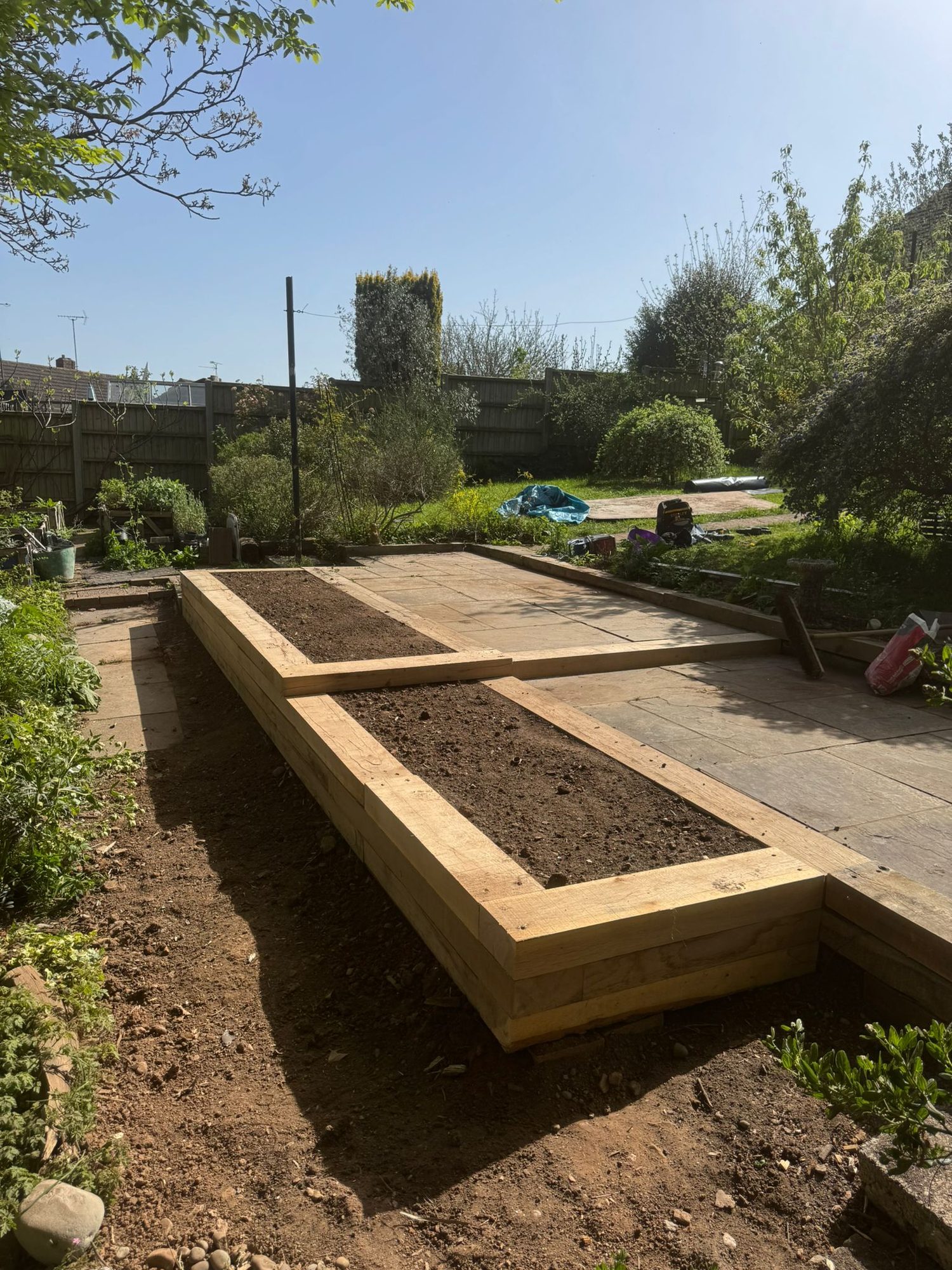
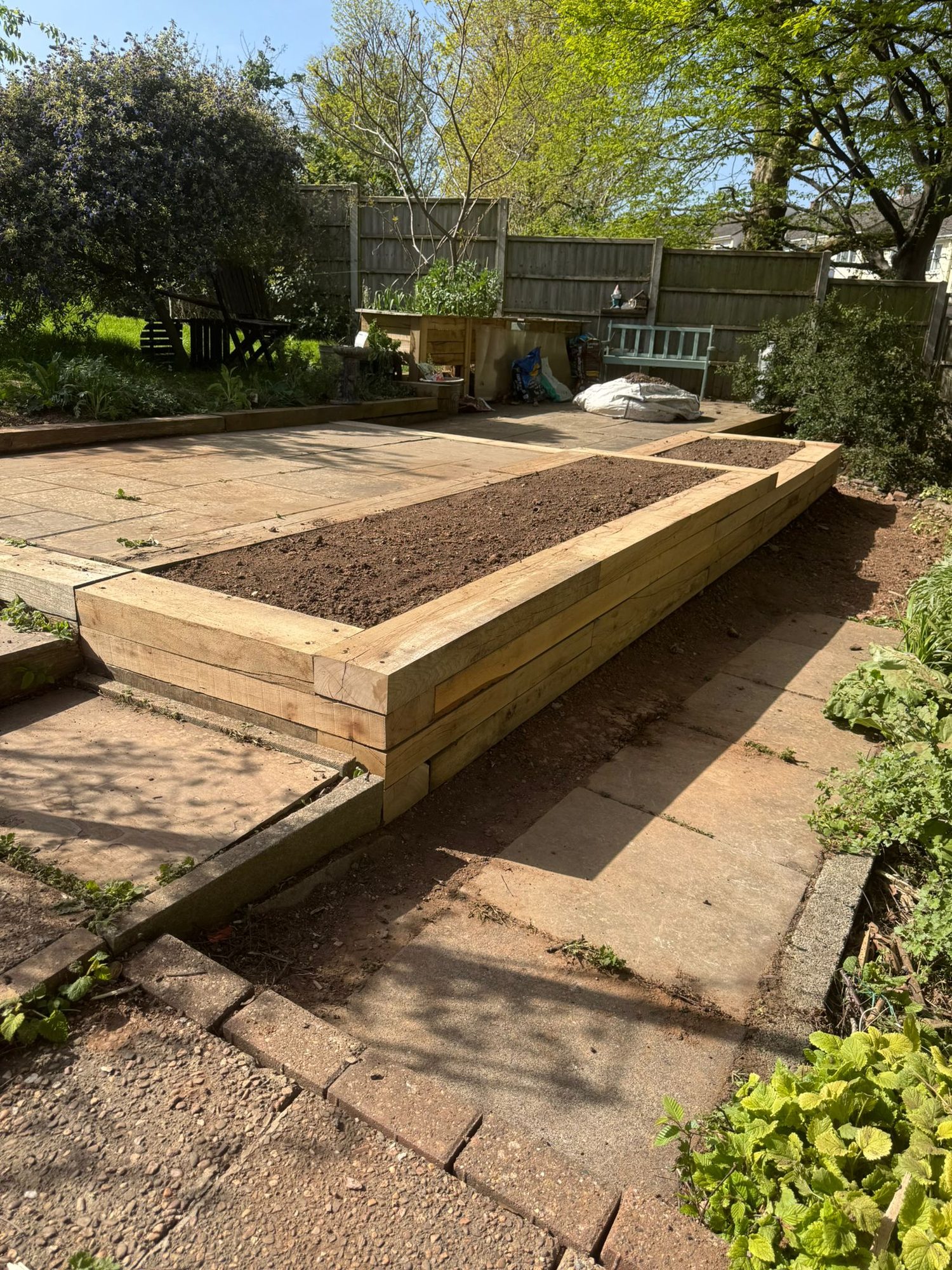
Sleepers cover a huge amount of practical ground: raised veg beds, planters, low retaining, steps into a slope, edging between lawn and gravel, and bin or storage enclosures. They go up quickly, sit well in a rural setting and pair naturally with the fencing and paving we build around them.
Who it is for
Homeowners wanting a level seating area on sloping or awkward ground, a raised growing area, or defined beds and storage built in timber.
When it is needed
When an existing deck is springy, slippery or rotting at the frame, when a slope makes a level patio expensive, or when planting needs to be raised out of poor soil.
Why a professional build matters
Joist spacing, ventilation, fixings and ground contact are what separate a deck that lasts from one that is soft underfoot in five years.
Works well alongside
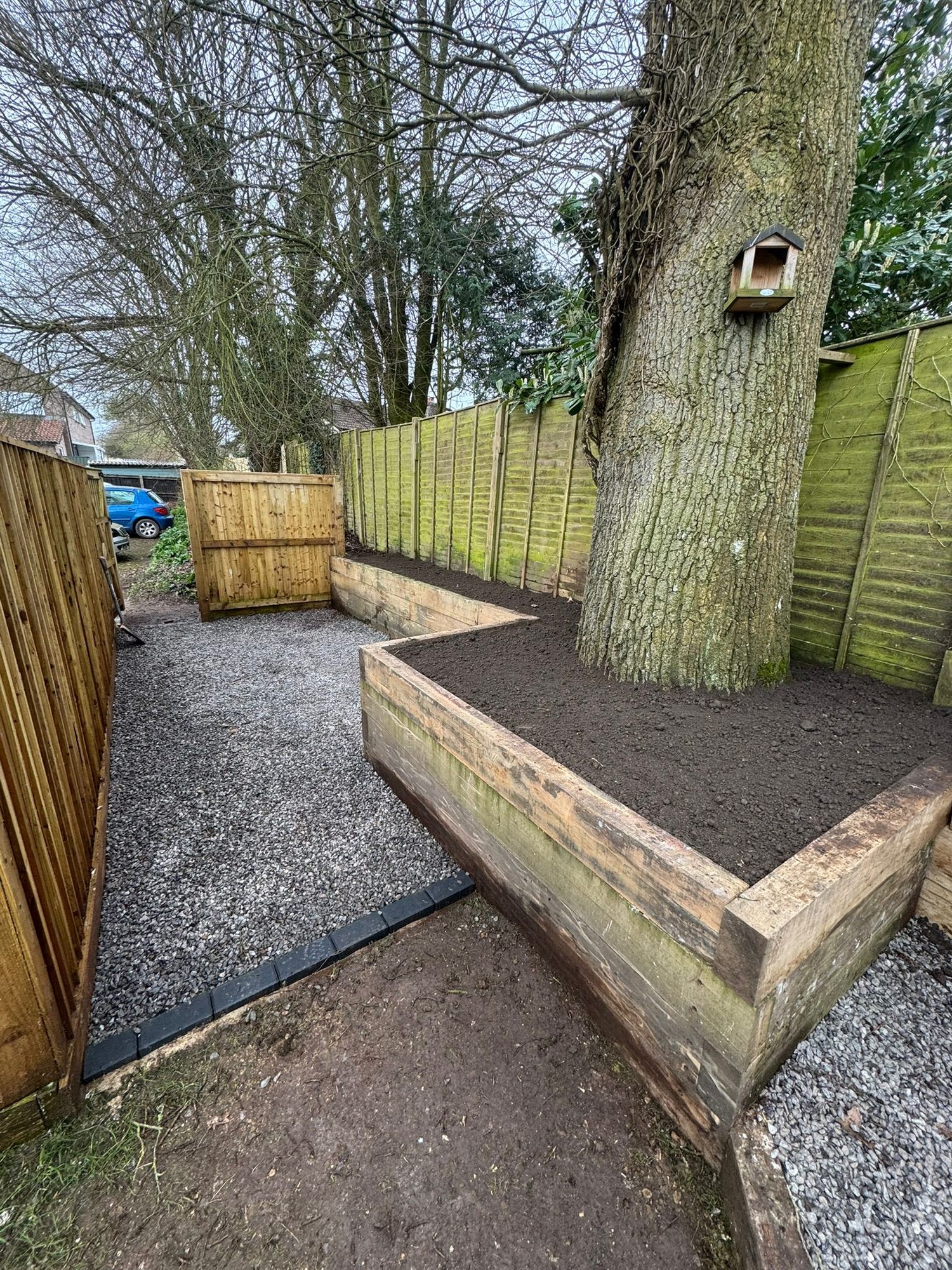
Sleeper beds and decking regularly sit within a wider scheme with patios, fencing and turf, as in the raised veg bed, fencing and bin store project we completed in Wellington.
Request your free quote
Free site visit, itemised written quote, typically back with you inside a week.
Prefer to talk it through? Call 07340 000463 between 8am and 8pm, Monday to Saturday.
What Happens If It Waits
How timber work goes wrong
Bounce is the first symptom of an undersized frame. Joists spanning too far or spaced too widely flex under foot, and that flex works the fixings loose, opens the board ends and lets water into every cut face. Once the frame is moving, re-screwing the boards is cosmetic; the structure underneath is the problem.
Rot almost always starts where timber meets ground or where water cannot escape. Posts concreted in without protection, bearers sitting on soil, sleeper beds with soil packed against untreated faces, and decks built too close to the ground with no ventilation all trap moisture. The visible boards can look sound while the frame beneath them is failing.
Slip is the safety issue people underestimate. A shaded deck in a wet Somerset winter can become genuinely dangerous, particularly on steps, and by the time it is noticeably slick the surface has usually built up a layer of algae that also holds water against the timber.
Common mistakes we are called in to fix
Joists spaced too far apart
Board thickness and span dictate joist centres. Stretch them to save timber and the deck flexes for the rest of its life.
No ventilation underneath
A deck built tight to the ground with no airflow stays damp all winter and rots from the frame outwards.
Untreated timber in soil contact
Sleepers and posts in permanent contact with wet soil need the right grade of timber and, where appropriate, a lining behind the face.
Building a deck on unprepared ground
Supports set on soft ground or a single paving slab settle unevenly, and the whole frame goes out of true with them.
Our Process
How we build decking and sleeper work
- 1
Free site visit and level check
We measure the area, check ground conditions and levels against doors and thresholds, and talk through use, board direction and whether steps or balustrade are needed.
- 2
Itemised written quote
Groundwork, frame, boards or sleepers, fixings, steps and any edging or infill are priced separately, usually with you within a week.
- 3
Written contract and dates
Scope, price and timings signed by both parties, 50% deposit by bank transfer and the balance on completion.
- 4
Ground preparation and frame
Ground is cleared and prepared, supports set to a solid bearing, and the frame built square and level with joists at the correct centres and airflow beneath.
- 5
Boards, detailing and clean down
Boards or sleepers are fixed with consistent spacing, cut ends sealed where appropriate, steps and edges detailed, and offcuts and packaging removed from site.
The Benefits
What proper timber work gives you
Solid underfoot
Correct joist centres and a square frame mean no bounce, no creak and no working fixings.
Longer service life
Ventilation, treated timber and keeping faces out of standing moisture is what keeps rot away from the frame.
Level space on a slope
Decking creates a usable, level seating area where building up to the same level in paving would mean a large retaining job.
Growing space that works
Raised sleeper beds give depth, drainage and warmth to soil, and put the growing area at a comfortable working height.
Joinery-standard detailing
Mitres, step nosings, planter corners and capping detailed by people with a carpentry and joinery background, not approximated.
Ties into the rest of the garden
Timber work is designed alongside the paving, fencing and planting so levels and lines meet properly.
In Detail
Timber types, structures and situations
Decking suits sloping ground, areas over poor or made-up ground, and situations where you want the finished surface at internal floor level without building up a large mass of hardcore. The frame is the job: supports on solid bearings, bearers and joists sized for the span, noggins where needed, and a clear ventilation gap beneath. Board choice affects grip and maintenance, and we will talk through where a grooved, smooth or textured surface makes sense given how much sun the area gets.
Sleepers are the most versatile timber element in a garden. Laid flat and stacked they make raised beds and planters; set upright they make low retaining and level changes; laid as treads they make generous garden steps. Fixings, tie-backs and a lining between soil and timber are what keep sleeper structures square and slow the moisture damage that eventually reaches any buried timber.
Raised beds deserve their own consideration. Height affects both comfort and cost: a bed high enough to work at without bending needs more soil volume and more structural restraint at the corners. Drainage matters too, since a sealed bed on compacted ground becomes a tank. We build beds with the depth and drainage the planting actually needs, as in the raised veg bed and gravel bin store project our Wellington client described as a complete transformation of an overgrown corner.
Timber also appears as pergolas, screens, bin and bike stores and planters within a wider landscaping scheme. Because the same team builds the groundwork, paving and fencing, these elements are built into the levels rather than dropped on top of them.
Garden decking
Framed timber decks on prepared ground, with steps, edge detailing and ventilation designed in.
Raised sleeper beds
Veg beds and planters at a comfortable working height, with drainage and corner restraint built in.
Sleeper steps and low retaining
Timber level changes on slopes and between terraces where masonry would be heavier than the job needs.
Stores, screens and pergolas
Bin and bike stores, screening and pergolas built to match the fencing and timber detailing elsewhere in the garden.
Decking & Sleepers we have built
Decking & Sleepers FAQs
Questions homeowners ask before booking
How much does decking cost?+
Decking and sleeper work is quoted per project, because the frame, ground preparation, height and steps vary so much between sites. Every element is priced separately in the written quote, and the site visit and quote are free.
How long does a deck take to build?+
Most domestic decks are a few days on site including ground preparation and the frame. Sleeper beds and planters are often quicker, and the written quote states the expected duration.
How long will a timber deck last?+
That depends almost entirely on the frame, the ventilation and whether timber sits in standing water. Built with airflow underneath, treated timber and the boards kept clear of soil, a deck gives many years of service with routine cleaning.
Is decking slippery in winter?+
It can be in shade if it is left uncleaned, because algae builds up. Board choice, an open aspect and an annual clean make a substantial difference, and we will advise on which surface suits the position at the site visit.
Decking or a patio, which should I choose?+
On sloping ground or where you want the surface at internal floor level, decking is often cheaper and quicker than building up to the same level in paving. On flat ground with full sun, paving generally lasts longer with less maintenance. We give an honest recommendation for your plot rather than a default answer.
How deep should a raised vegetable bed be?+
Deep enough for what you plan to grow and high enough to work at comfortably. Greater height means more soil volume and more restraint at the corners, both of which we allow for in the build and the quote.
Can you replace the boards on my existing deck?+
Sometimes, but only if the frame beneath is genuinely sound. If the joists are soft, undersized or sitting in moisture, new boards on an old frame is money spent twice. We will tell you which situation you are in at the visit.
Do you build timber work as part of a bigger garden project?+
Very often. Sleeper beds, decking, bin stores and fencing regularly form part of a wider scheme with paving and turf, and quoting them together avoids paying twice for access and set-up.
Related Services
Work that often goes with decking & sleepers
Where We Work
Decking & Sleepers across Somerset & Mid Devon
- Wellington
- Taunton
- Tiverton
- Chard
- Somerton
- Ilminster
- Wiveliscombe
- Milverton
- Cullompton
- Sampford Peverell
- Bishops Lydeard
- Langport
Based at 14 Lower Westford, Wellington, Somerset. Open 8am – 8pm, Monday to Saturday. Contact us.
Get your timber work built by people who know joinery
Free site visit, itemised written quote usually back within a week, and a written contract before anything is ordered.
Family-run · 6 years landscaping · Written contract on every job · 50% deposit, balance on completion